

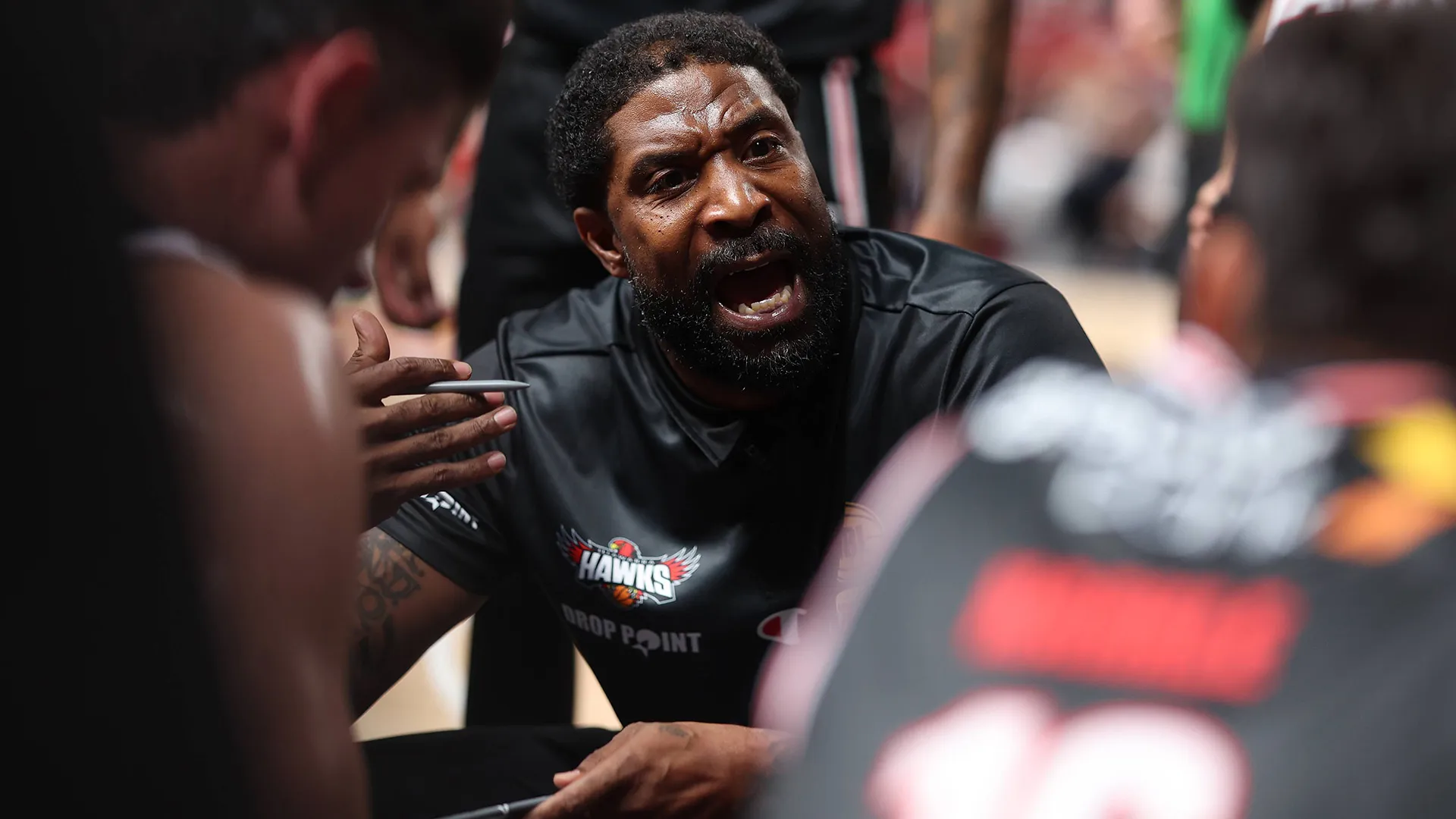
Larry Bird believed players began tuning out coaches after three years. Pat Riley reportedly put the limit at five, while Steve Kerr admitted his Golden State players were tired of hearing him in his fourth season. Now Justin Tatum is in his fourth season with Illawarra, and the Hawks have gone from NBL champions to the bottom of the ladder. Could they be experiencing the same problem?
Justin Tatum transformed Illawarra from one of the NBL’s worst teams into champions. But ahead of today’s clash with Melbourne United, the Hawks have won just one of seven games and are conceding more points than any other team.
Perhaps most concerning is that seven players from their championship team remain, including key contributors Sam Froling, Tyler Harvey and Will Hickey.
Almost three years after Tatum arrived, could those players be growing tired of hearing the same message?
It’s a question some of basketball’s greatest coaches have confronted.
In February 2018, during his fourth season coaching Golden State, Steve Kerr made an extraordinary admission.
“They’re tired of my voice. I’m tired of my voice.”
Despite winning two championships in his first three seasons, Kerr admitted he was struggling to reach his players. He responded by allowing his veterans to run timeouts during a 129 to 83 victory over Phoenix.
Golden State went on to win another championship that season.
Kerr wasn’t alone in believing a coach’s message could lose its impact.
LARRY BIRD BELIEVED THREE YEARS WAS ENOUGH
When Larry Bird decided not to renew Frank Vogel’s contract with Indiana in May 2016, the decision surprised much of the basketball world.
Vogel had coached the Pacers for five and a half seasons, compiling 250 wins and 181 losses, reaching consecutive Eastern Conference Finals in 2013 and 2014, and completing a 45 win season.
Nevertheless, Bird believed Indiana needed a change.
“My experience has been good coaches leave after three years,” Bird explained.
Bird believed players eventually became accustomed to the same instructions, criticism and motivational messages.
“Every day the same voice and the same, I think guys sometimes tune that out,” Bird said.
His philosophy came partly from his playing career in Boston, where he watched Bill Fitch depart after four seasons and K.C. Jones leave after five despite winning two championships.
Bird recalled discussing coaching turnover with legendary Celtics executive Red Auerbach and recognised that even successful coaches could eventually lose some of their influence.
Perhaps the strongest evidence of Bird’s belief was that he followed his own advice.
Appointed Indiana’s head coach in 1997, Bird committed to just three seasons. He recorded 147 wins and 67 losses, won NBA Coach of the Year and reached three Eastern Conference Finals, including the 2000 NBA Finals, before stepping down.
When explaining Vogel’s departure in 2016, Bird acknowledged that he couldn’t definitively say his coach had lost the locker room.
He simply believed even successful organisations could benefit from a different voice.
Read NBC Sports’ examination of Larry Bird’s coaching philosophy.
PAT RILEY AND PHIL JACKSON SHARED SIMILAR BELIEFS
Pat Riley won four NBA championships coaching the Showtime Lakers during the 1980s, but the relentless intensity that helped create that success could also wear on his players.
In a 2004 Los Angeles Times article, columnist J.A. Adande recalled Riley expressing the belief that players began tuning out a coach after five years.
Former Lakers superstar Kareem Abdul-Jabbar reinforced that perspective when discussing Riley’s psychological approach:
“That wears thin, very thin, very quickly.”
Phil Jackson, who won 11 NBA championships with Chicago and the Lakers, also questioned how long a coach could remain effective with the same group.
In June 1996, after guiding Chicago to its fourth championship in six seasons, Jackson explained why he had considered leaving.
“I thought it was going to be the farewell tour this year because it was my seventh year,” Jackson said.
He ultimately stayed and won another two championships with Chicago before winning five more with the Lakers.
Their careers demonstrate that coaching relationships don’t automatically expire after a particular number of years, but maintaining influence over a successful playing group can become increasingly challenging.
Read the Los Angeles Times’ examination of Riley’s belief.
Read Jackson’s comments in the June 1996 Los Angeles Times report.
TATUM’S FIRST TWO SEASONS WERE A HUGE SUCCESS. THE NEXT TWO HAVEN’T BEEN
Justin Tatum’s appointment as Illawarra’s interim head coach in November 2023 immediately changed the direction of the franchise.
He replaced Jacob Jackomas after the Hawks opened the season with two wins from nine games, having finished the previous campaign at the bottom of the ladder with just three wins.
Under Tatum, Illawarra recovered to finish the 2023/24 regular season with 14 wins and 14 losses, qualifying for the postseason and pushing Melbourne United to a deciding third game in the semifinals.
His first full season was even more successful.
In 2024/25, Illawarra finished on top of the ladder with 20 wins and nine losses before defeating Melbourne United in five games to claim the club’s first NBL championship since 2001.
But the following season delivered a significant decline, with Illawarra finishing eighth and missing the postseason.
Now, seven games into 2026/27, the Hawks have just one win and six losses.
The progression is interesting when compared with Bird’s theory.
Season one (2023/24): Tatum takes over and reaches the semifinals.
Season two (2024/25): Illawarra finishes first and wins the championship.
Season three (2025/26): The Hawks regress significantly, finishing eighth and missing the playoffs.
Season four (2026/27): Illawarra opens with six losses from seven games and sits last on the ladder.
There are important circumstances surrounding that decline.
Sam Froling ruptured his Achilles during Game 4 of the 2025 Championship Series and missed the first half of the following season, only returning on Christmas Day.
Illawarra also experienced player departures, other injuries and significant changes to its rotation.
But Tatum’s first two seasons established a defensive identity that helped take Illawarra to the top of the league, and his team is now struggling to reproduce those same standards.
HAS TATUM BECOME TOO FAMILIAR?
Perhaps the strongest connection between Illawarra’s current struggles and the coaching theories is the continuity within the playing group.
Seven members of the 2025 championship team remain at Illawarra, all of whom were already playing for the Hawks when Tatum took charge in November 2023.
They are Sam Froling, Tyler Harvey, Daniel Grida, Will Hickey, Wani Swaka Lo Buluk, Todd Blanchfield and Mason Peatling.
Five remain part of Illawarra’s regular rotation.
Froling and Harvey are the club’s captains and two of its most experienced offensive contributors. Hickey has developed into an important scoring and playmaking option under Tatum, while Grida and Swaka Lo Buluk were important members of the championship team’s defensive rotation.
Blanchfield and Peatling are currently sidelined, with Peatling ruled out for the remainder of the season.
These five active players experienced Tatum’s arrival, embraced his coaching methods and celebrated a championship together.
They understand his defensive system, training standards and expectations around communication and accountability.
They’ve already demonstrated they can execute his instructions successfully.
Interestingly, Tatum himself made a comment about the importance of familiarity when first taking charge.
On 16 November 2023, after replacing Jacob Jackomas, Tatum explained why he believed he could connect with the struggling Hawks.
“At the end of the day, these guys want a consistent, familiar voice and hopefully I can be that person.”
That familiarity helped Illawarra become champions.
Perhaps he’s now become too familiar.
ILLAWARRA’S DEFENCE HAS GONE FROM ONE OF THE BEST TO THE WORST
During their 2024/25 championship season, Illawarra conceded 91.2 points per game, the third fewest in the NBL.
Through seven games of 2026/27, that figure has increased to 108 points, the most in the competition.
That’s an additional 16.8 points conceded per game, an increase of 18.4 per cent.
| Defensive statistic | 2024/25 | 2026/27 |
|---|---|---|
| Points conceded per game | 91.2 | 108.0 |
| League rank for points conceded | 3rd best | 10th |
| Opponent field goal percentage | 44.1% | 51.1% |
| Opponent two point percentage | 51.8% | 60.8% |
| Opponent turnovers per game | 12.0 | 9.9 |
| Defensive rating | 110.7* | 132.1* |
*The historical defensive rating is reported by BeBasket, while the current rating is reported by the NBL. Different providers can calculate possessions slightly differently, so these ratings should be treated as an indicative comparison rather than an exact measure of change.
Illawarra’s defensive decline extends beyond the points they’re conceding.
During their championship season, opponents shot 51.8 per cent on two point attempts. That figure has climbed to 60.8 per cent this season, an increase of nine percentage points.
The Hawks are also forcing fewer turnovers, dropping from 12 per game during their championship campaign to just 9.9 this season, approximately 18 per cent fewer.
Those figures suggest Illawarra is struggling to contain opponents inside the three point line and disrupt their offensive possessions as frequently as it once did.
View Illawarra’s championship season statistics.
View the Hawks’ current season shooting statistics.
The defensive struggles are particularly concerning considering Illawarra’s offence remains highly productive.
According to the Hawks’ October 17 match preview, they’re averaging 99.7 points per game, the second highest total in the NBL, and lead the competition in fast break points, points in the paint and bench scoring.
The championship figures cover a complete 29 game regular season, while the current numbers represent just seven games.
Illawarra has also lost important championship contributors including Trey Kell, Lachlan Olbrich and Hyunjung Lee, making direct comparisons more complicated.
Nevertheless, the defensive deterioration is substantial.
If Froling, Harvey, Hickey, Grida and Swaka Lo Buluk have already spent almost three years learning and executing Tatum’s system, why has the team’s defensive performance deteriorated so significantly?
In August, Tatum spoke about returning to the approach that delivered the championship.
“If it wasn’t broke, don’t fix it,” he said when discussing the need to return to the Hawks’ previous standards.
Read the NBL’s August report on Tatum’s plans.
But is returning to the same methods enough, or does Tatum need to find a different way of delivering his message?
HAS THE NBL SEEN THIS BEFORE?
There are examples of NBL coaches experiencing similar situations, including within Illawarra itself.
Rob Beveridge, Illawarra Hawks
Beveridge took charge in 2015 and immediately transformed the Hawks into a finals contender.
His first season produced 17 wins and 11 losses and a semifinal appearance. In his second, Illawarra finished with 15 wins and 13 losses and reached the 2017 Grand Final.
But the Hawks regressed to 12 wins and 16 losses in his third season, missing the playoffs. They recorded the same result in his fourth before his tenure ended in 2019.
Like Tatum, Beveridge delivered immediate success before experiencing a significant third season decline, although there is no verified evidence his players stopped listening to him.
Simon Mitchell, South East Melbourne Phoenix
Mitchell coached South East Melbourne for four seasons, guiding the expansion club to two postseason appearances before departing in February 2023.
Following his fourth campaign, Mitchell acknowledged that he was no longer the right person to lead the group and believed a different voice might give the Phoenix a better chance of success.
BRIAN GOORJIAN LEARNT TO USE HIS VOICE LESS
Brian Goorjian, one of the most successful coaches in NBL history, has also discussed recognising when coaching relationships and methods need to change.
In an August 2021 interview, Goorjian explained that his coaching philosophy included identifying when players were no longer responding to a particular system.
“As a coach, you have to sense, this [situation] is starting to wane,” Goorjian said.
He also discussed how his decade coaching in China had changed the way he communicated with players.
“I learnt more flow at practice, less of my voice,” he explained.
Working through interpreters forced Goorjian to simplify instructions, reduce lengthy conversations and develop practices where players could learn without constantly hearing him speak.
Those lessons influenced the approach he brought to the Australian Boomers during their bronze medal campaign at the Tokyo Olympics.
Goorjian wasn’t suggesting that his players had stopped listening to him. Rather, he recognised that changing how he delivered instructions could make him a more effective coach.
It’s a lesson with obvious relevance to Tatum, whose current players have spent almost three years hearing the same defensive instructions and demands.
IS TATUM STILL GETTING THROUGH TO HIS PLAYERS?
The Hawks’ 114 to 92 victory over Adelaide on October 2 demonstrated that they remain capable of delivering the energy and execution Tatum demands.
Injuries also deserve consideration. Froling missed much of last season, while Peatling’s season ending foot injury and Blanchfield’s current absence have affected the 2026/27 rotation.
Ahead of today’s 5 pm AEDT clash at John Cain Arena, Melbourne United coach Jacob Chance has warned against underestimating Illawarra despite its poor start.
Chance pointed to the Hawks’ championship experience and available talent, acknowledging that United would need to be at their best against a team capable of scoring quickly in transition.
Whether Illawarra’s struggles reflect coaching fatigue, injuries, roster construction, individual performances or a combination of those factors remains uncertain.
Kerr’s 2018 championship demonstrates that recognising a problem with the delivery of a coach’s message doesn’t necessarily require replacing the coach.
Goorjian’s experience offers a similar lesson, showing that even the most successful coaches can benefit from speaking less and allowing players greater responsibility.
Today’s meeting with Melbourne United, the team Illawarra defeated to win the 2025 championship, offers another opportunity to assess whether the Hawks can rediscover their defensive standards.
One game won’t settle Larry Bird’s coaching theory. But another poor defensive performance would only intensify the questions surrounding Illawarra and Justin Tatum.